In 2026, the biggest risk in crypto is no longer choosing the wrong coin.
It is storing the right one incorrectly.
Every cycle produces stories of traders who made the right calls, only to lose everything due to poor storage decisions. Not because the market turned. Not because their strategy failed. But because their security model had a single weak point.
Bitcoin does not forgive mistakes in custody.
Once it is gone, it is gone.
For people who trade or hold cryptocurrency for a long time, storing it safely is a big part of their plan. They don’t just think about it after they’ve already bought their coins. In the world of crypto, security is everything – it’s the base that everything else is built on.
Why Bitcoin Storage Matters More Than Ever in 2026

Crypto adoption has grown. So has the sophistication of attacks.
Phishing has become more targeted. Malware is more advanced. Social engineering is more convincing. At the same time, traders now operate across multiple exchanges, wallets, and DeFi platforms.
This creates complexity.
And complexity creates vulnerability.
The safest Bitcoin storage methods in 2026 are not just about avoiding hacks. They are about eliminating single points of failure.
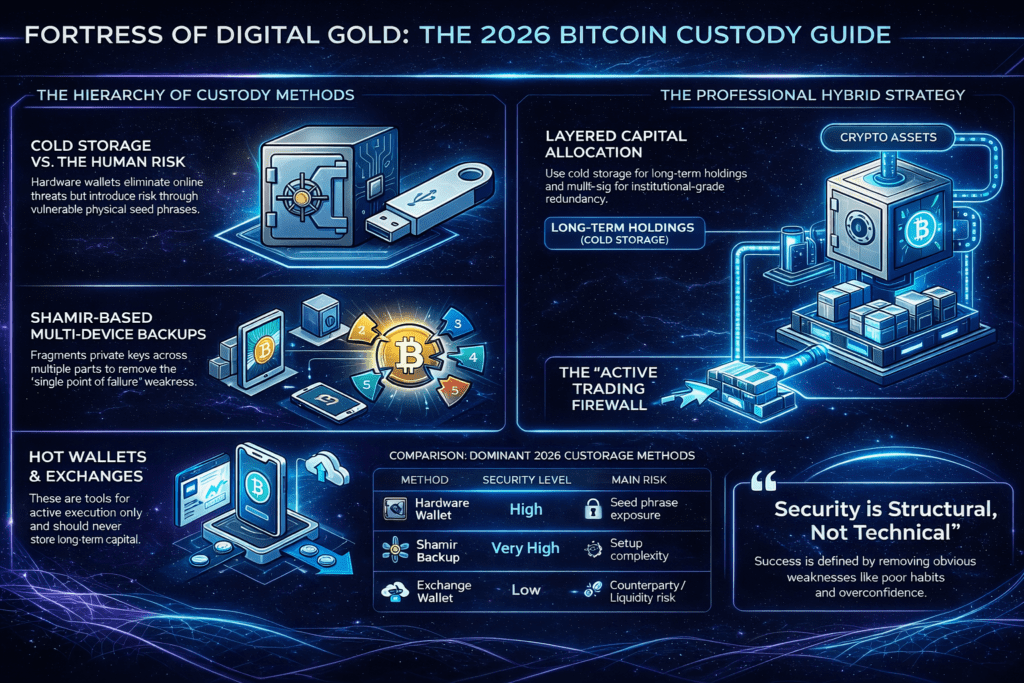
Cold Storage (Hardware Wallets)
Cold storage is still the best way to keep your Bitcoin safe.
A hardware wallet is a safe way to store your private keys because it keeps them offline. This means they are not connected to the internet, so most remote attacks can’t get to them. By keeping your keys offline, you’re protecting yourself from a lot of potential threats.
These days, people who are really into cryptocurrency rely on devices like Trezor, Ledger, Cypherock, Keystone, and BitBox to keep their funds safe. They’re super important for anyone who’s serious about holding onto their digital assets.
However, traditional hardware wallets come with one major risk.
The seed phrase.
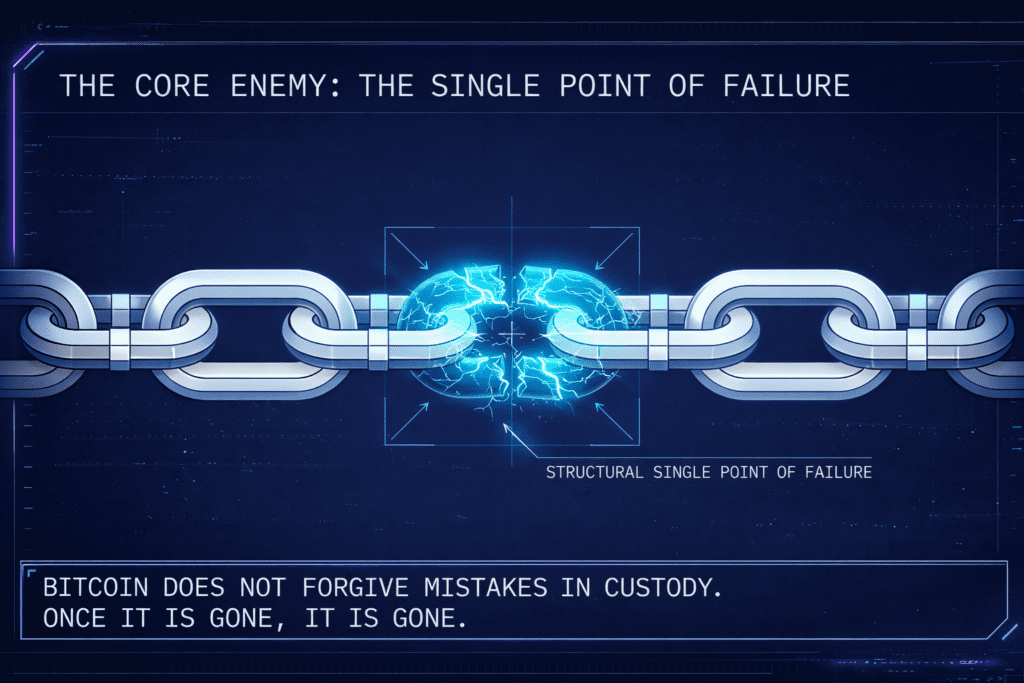
If someone gets their hands on that recovery phrase, they’ll have complete control over the wallet.
This is why cold storage is secure, but not perfect.
It removes online risk, but introduces human risk.
Multi-Device Backup Systems (Shamir-Based Storage)
The biggest evolution in Bitcoin storage is the move away from single seed phrases.
Systems based on Shamir’s Secret Sharing divide the private key into multiple fragments. No single piece can unlock the wallet.
Cypherock X is one of the leading examples of this approach.
This approach is different from using just one recovery phrase to keep your money safe. It spreads your private key across several hardware parts. So, even if someone loses or steals one of these parts, your funds will still be protected.
This system gets rid of the biggest weakness in storing cryptocurrencies.
The single point of failure.
This way of doing things is now the norm for people who trade or invest a lot of money. It’s becoming the standard approach for those with big investments.
Multi-Signature Wallets
Multi-signature wallets require multiple approvals to authorize a transaction.
For instance, let’s say you have a wallet that needs two out of three keys to transfer money – this is a basic example of how security can be set up to protect your funds.
This method is commonly used by:
- Institutional investors
- Funds and treasury managers
- High-net-worth individuals
The advantage is clear, and your money is still safe even if someone gets hold of one of the keys.
The tradeoff is complexity. Multi-signature setups require more technical understanding and coordination.
For professionals, this complexity is acceptable.
For beginners, it can be overwhelming.
Hot Wallets (For Active Trading Only)
Hot wallets are connected to the internet.
They are convenient. They are fast. And they are risky.
Platforms like MetaMask, Trust Wallet, and exchange wallets allow traders to move funds quickly, interact with DeFi, and execute trades in real time.
But convenience comes at a cost.
Hot wallets are exposed to:
- Phishing attacks
- Malware
- Smart contract vulnerabilities
By 2026, most people who work with cryptocurrency will only use hot wallets for the money they’re actively trading, not for storing all their assets.
They do not store long-term holdings in them.
The rule is simple.
If it is online, it is vulnerable.
Exchange Wallets (The Hidden Risk)
Leaving Bitcoin on an exchange remains one of the most common mistakes.
Exchanges are convenient, but they introduce counterparty risk.
History has shown that even large platforms can fail due to:
- Hacks
- Regulatory issues
- Liquidity problems
In 2026, this risk has not disappeared.
Professional traders use exchanges for execution, not storage.
Funds are moved into trade.
Funds are moved out to secure wallets.
The difference between amateurs and professionals is often this simple.
Professionals do not leave capital exposed longer than necessary.
Hybrid Strategy: How Professionals Actually Store Bitcoin
In 2026, it’s probably a good idea to not put all your eggs in one basket.
It is combining them.
A typical professional setup looks like this:
- Cold storage for long-term holdings
- Shamir-based or multi-sig systems for redundancy
- Hot wallets for active trading capital
- Minimal funds kept on exchanges
This layered approach reduces risk across multiple vectors.
It acknowledges that no single system is perfect.
But together, they create resilience.
Comparison: Bitcoin Storage Methods in 2026
| Method | Security Level | Best For | Main Risk |
| Hardware Wallet | High | Long-term holding | Seed phrase exposure |
| Shamir Backup Wallet | Very High | Large portfolios | Setup complexity |
| Multi-Signature Wallet | Very High | Institutions and advanced users | Coordination complexity |
| Hot Wallet | Medium | Active trading | Online vulnerabilities |
| Exchange Wallet | Low | Short-term execution | Counterparty risk |
FAQs: Bitcoin Storage in 2026
What is the safest way to store Bitcoin?
Cold storage combined with multi-device backup or multi-signature systems offers the highest security.
Should I keep Bitcoin on an exchange?
Only for active trading. Long-term storage should always be offline.
What happens if I lose my seed phrase?
If you don’t have a backup, your money is gone for good.
Are hardware wallets completely safe?
They’re really secure, but you still need to protect your seed phrase properly.
Is Shamir Backup better than a seed phrase?
This makes it a lot safer for people who have a lot of money invested, because it spreads out the risk so that everything doesn’t depend on one single thing.
Bitcoin security is not about finding a perfect system, it is about removing obvious weaknesses.
The biggest risks in crypto are rarely technical.
They are structural.
Single points of failure. Poor habits. Overconfidence.
The safest investors in 2026 are not the ones taking the least risk in the market.
They’re playing it safe when it comes to storing their stuff, not taking any big chances.
In the world of cryptocurrency, you don’t gradually lose your Bitcoin – it’s a different story altogether.
You lose it all at once.
Where Traders Learn to Protect Capital Like Professionals
Security is not something most traders think about until it is too late. Professional traders approach it differently.
Inside ParadiseFamilyVIP, storage strategies, risk management, and capital protection are treated as part of the trading system itself.
Making money in crypto is just the beginning, the real challenge is holding onto it and making it grow over time.
Keeping it is what defines success.