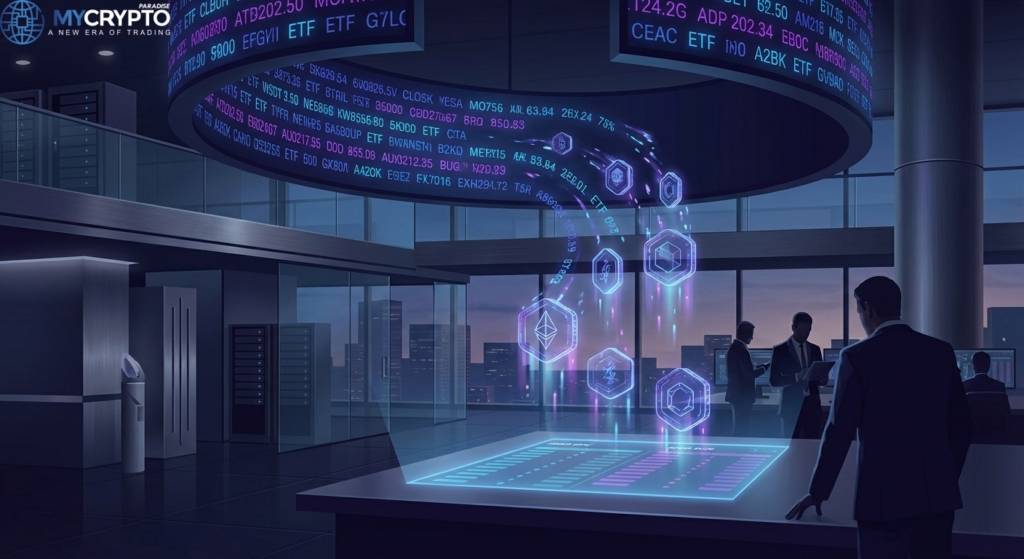
• SEC has approved Nasdaq’s rule change allowing tokenized stocks and ETFs to trade alongside traditional shares on the same order book.
• Tokenized and traditional securities will share the same CUSIP and investor rights, with settlement determining the holding format.
• This marks the first full regulatory green light for tokenized securities at scale on a major U.S. exchange.
When Wall Street stops talking about tokenization and starts wiring it into its core systems, the question shifts from “if” to “how fast.”
The U.S. Securities and Exchange Commission has approved Nasdaq’s proposal to enable tokenized securities trading directly on its exchange, allowing stocks and ETFs to exist in both traditional and tokenized forms under the same framework.
Under this structure, tokenized and traditional shares will share identical identifiers and rights, including dividends and voting. Orders for both formats will sit on a unified order book, with settlement determining whether positions are held in tokenized or conventional form.
This is the first time a major U.S. equity exchange has received full regulatory approval to integrate tokenized securities into its core trading infrastructure. It effectively connects blockchain-based settlement rails with traditional market structure, rather than isolating them in crypto-native environments.
Why Nasdaq Tokenized Securities Approval Matters for Crypto
This is a structural shift in market plumbing, not just another crypto headline.
Tokenization has spent years being presented as a future upgrade to finance. With this approval, it quietly becomes part of the present. Nasdaq is not experimenting on the edges. It is embedding blockchain rails inside the same system that handles trillions in equity volume.
For crypto, this reduces the distance between traditional capital and on-chain infrastructure. The more assets that can move between formats seamlessly, the more relevant blockchain becomes as a settlement layer rather than just a speculative playground.
It also reframes tokenization from a niche narrative into a regulated pathway. Institutions that previously avoided tokenized assets due to compliance risk now have a clear, approved framework to engage.
Market Impact of Tokenized Securities on Nasdaq
The immediate price impact may be limited, but the structural implications are not.
First, this strengthens the real-world asset narrative. If tokenized stocks gain traction, it reinforces demand for infrastructure around custody, settlement, and interoperability. That includes compliant stablecoins, tokenization platforms, and cross-chain liquidity solutions.
Second, it introduces the possibility of faster and more flexible settlement models. While not fully 24/7 yet, the foundation is now in place. Over time, this could reshape how liquidity flows between traditional markets and crypto markets, especially during off-hours.
Third, it creates competitive pressure. Other exchanges, both in the U.S. and globally, will not want to be left behind if tokenized trading volumes begin to scale.
What to Watch Next for Nasdaq Tokenized Securities
Watch how quickly tokenized volumes actually grow. Approval is step one. Adoption is what matters.
Pay attention to whether institutional desks begin using tokenized formats for collateral movement, cross-venue transfers, or balance sheet efficiency. That is where the real utility lies.
Also monitor regulatory follow-through. If the SEC expands or clarifies rules around tokenized assets, it could accelerate broader integration across markets.
Finally, watch whether this begins to connect with stablecoin rails and DeFi infrastructure. The moment tokenized equities start interacting with on-chain liquidity, the narrative shifts from parallel systems to converging systems.
Insights for Traders on Tokenized Securities and Market Structure
Smart money is not looking at this as a short-term trade. They are looking at it as a map of where market structure is heading.
Large players are likely thinking about efficiency. If tokenized securities allow faster settlement, better collateral usage, or lower operational friction, they will gradually shift flows in that direction. Not overnight, but steadily.
The second-order effect is where it gets interesting. As tokenized assets scale, demand for compliant on-chain infrastructure increases. That means more attention on custody providers, tokenization platforms, and networks that can handle regulated financial activity.
There is also a subtle shift in narrative risk. Crypto is no longer just competing with traditional finance. It is being integrated into it. And once integration begins, it tends to move in one direction.
In simple terms, this is not about whether tokenization works. It is about who captures the value when it does.
ParadiseTeam is monitoring the market situation closely, and we are taking these developments into consideration while building our trading tactics inside ParadiseFamilyVIP.