

Future Crypto Trends
In short
Future crypto trends will likely focus on infrastructure, utility, and technological convergence rather than pure speculation. Identifying these emerging themes before widespread adoption is key for understanding market evolution. This approach helps in recognizing which sectors are positioned for the next phase of capital and innovation.
The top crypto trends in 2026 are unlikely to be the same narratives dominating headlines today. Every major crypto cycle creates new winners, but history shows that the biggest opportunities often emerge before the crowd fully understands them.
In 2021, NFTs exploded. In 2024 and 2025, institutional Bitcoin adoption, AI-related tokens, and real-world asset tokenization captured attention. As the market matures, the next phase appears less focused on speculation alone and more focused on infrastructure, utility, and the convergence of multiple technologies.
For investors, traders, and long-term market observers, the question is no longer whether crypto will evolve. The question is which sectors are positioned to capture the next wave of capital, innovation, and user adoption.
This guide explores the crypto trends that could define 2026 and explains why many industry professionals are already paying close attention to them.
Why Crypto Trends Matter More Than Individual Coins
One of the most common mistakes in crypto investing is focusing exclusively on individual tokens.
Professional investors often start somewhere else. They identify emerging themes first, then evaluate which projects are best positioned to benefit from those themes.
This approach matters because capital rarely flows randomly. It tends to move through sectors. When a narrative gains momentum, multiple projects within that category often experience increased attention, liquidity, and development activity.
Understanding trends helps investors answer a more important question:
Where is the market likely to focus next?
What Makes a Crypto Trend Explosive?
Not every trend becomes a market-moving force.
The most powerful crypto trends typically combine:
- Growing real-world demand
- Strong developer activity
- Institutional interest
- Expanding user adoption
- Clear revenue or utility models
- Market narratives that attract attention
When several of these factors align simultaneously, sectors can grow far faster than expected.
Trend #1: AI Agents and Autonomous Crypto Systems
Artificial intelligence and blockchain are becoming increasingly interconnected.
The first wave of AI crypto projects focused primarily on infrastructure and data. The next phase may revolve around autonomous AI agents capable of performing tasks, managing assets, interacting with smart contracts, and making decisions without direct human intervention.
Potential applications include:
- Automated portfolio management
- AI-powered DeFi strategies
- Smart contract execution
- Autonomous trading systems
- Decentralized digital assistants
What makes this trend compelling is the combination of two of the fastest-growing technology sectors globally: artificial intelligence and decentralized finance.
The intersection of these industries could create entirely new economic models.
Trend #2: Real-World Asset (RWA) Tokenization
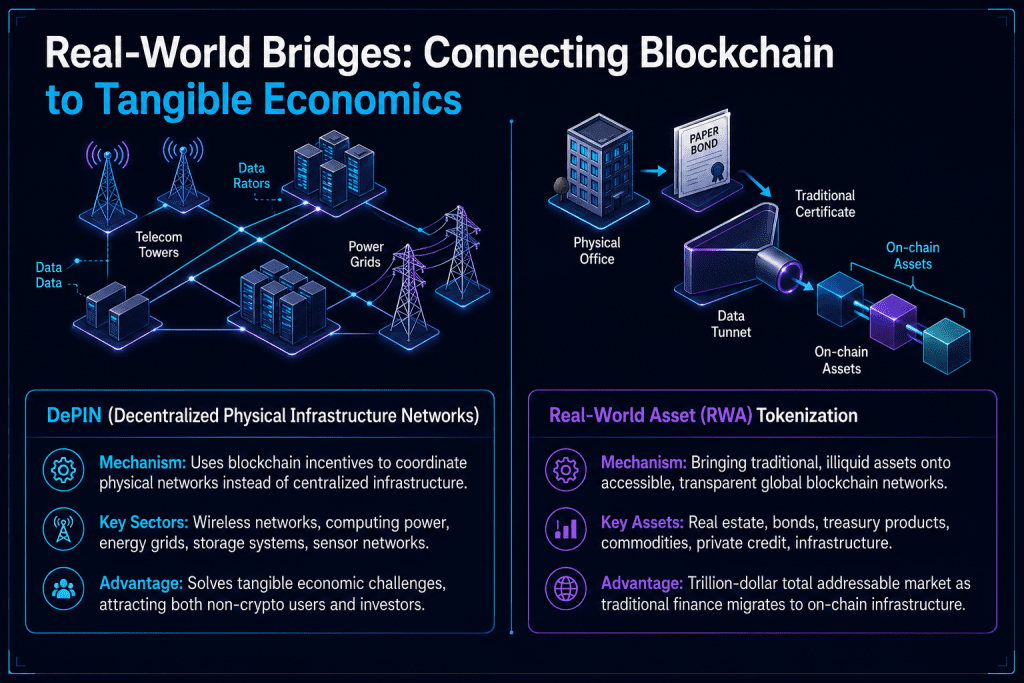
Tokenization continues to attract attention from institutions because it solves a major problem: liquidity.
Real-world asset tokenization refers to bringing traditional assets onto blockchain networks, including:
- Real estate
- Bonds
- Treasury products
- Commodities
- Private credit
- Infrastructure investments
The appeal is straightforward. Tokenized assets can become more accessible, more transparent, and easier to transfer globally.
Many analysts believe the long-term opportunity could reach trillions of dollars as traditional financial assets gradually migrate onto blockchain infrastructure.
For this reason, RWA projects remain one of the strongest crypto trends heading into 2026.
Trend #3: Institutional Crypto Infrastructure
For years, crypto was largely retail-driven.
That dynamic is changing.
Large financial institutions now require:
- Secure custody
- Compliance solutions
- Trading infrastructure
- Risk management systems
- Settlement networks
As institutional participation grows, the demand for enterprise-grade blockchain infrastructure is likely to increase as well.
The companies and protocols enabling this transition may become some of the most important beneficiaries of the next growth cycle.
Trend #4: Bitcoin Ecosystem Expansion
Bitcoin remains the largest and most secure cryptocurrency network.
However, 2026 may see increasing focus on what can be built around Bitcoin rather than simply holding it.
Areas receiving growing attention include:
- Bitcoin Layer-2 solutions
- Bitcoin DeFi
- Ordinals ecosystems
- Bitcoin-backed financial products
- Cross-chain integrations
Historically, Bitcoin’s primary role was value storage.
The next phase may involve expanding utility while maintaining its core security advantages.
Trend #5: DePIN (Decentralized Physical Infrastructure Networks)
DePIN has quietly become one of the most discussed sectors among industry insiders.
Instead of building centralized infrastructure, DePIN projects use blockchain incentives to coordinate physical networks.
Examples include:
- Wireless networks
- Computing infrastructure
- Energy grids
- Storage systems
- Sensor networks
The concept is powerful because it connects digital incentives with real-world infrastructure.
Unlike purely speculative narratives, DePIN projects often address tangible economic challenges.
That combination may prove attractive to both investors and users.
Trend #6: Blockchain Gaming 2.0
The first generation of blockchain gaming struggled with sustainability.
Many projects focused more on token speculation than gameplay.
The next generation appears different.
Developers are increasingly prioritizing:
- High-quality game experiences
- Sustainable token economies
- Player ownership
- Cross-platform functionality
- Invisible blockchain integration
The strongest blockchain games in 2026 may succeed not because they are crypto games, but because they are genuinely good games that happen to use blockchain technology.
That distinction could be critical.
Trend #7: Privacy Technologies and Data Ownership
As artificial intelligence expands, data becomes increasingly valuable.
At the same time, concerns around privacy continue to grow.
This creates opportunities for blockchain projects focused on:
- Data sovereignty
- Privacy-preserving computation
- Identity management
- Secure communications
- Decentralized credentials
Many observers believe future internet infrastructure will place greater emphasis on user-controlled data.
Blockchain technology may play a significant role in enabling that transition.
Trend #8: SocialFi and Creator Economies
Social media remains one of the largest industries on the internet.
Yet creators often have limited ownership of their audiences.
SocialFi aims to change that by combining:
- Social networks
- Digital ownership
- Community incentives
- Creator monetization
- Decentralized identity
While the sector remains early, successful SocialFi models could fundamentally reshape how communities and creators interact online.
Trend #9: On-Chain Financial Intelligence
As crypto markets become more sophisticated, information advantages become increasingly valuable.
The next generation of traders is not simply analyzing price charts.
They are combining:
- Whale tracking
- Sentiment analysis
- On-chain analytics
- Volume divergence
- Volatility monitoring
- Cross-market intelligence
The ability to process large amounts of market data quickly is becoming a competitive edge.
This trend is particularly important because it influences decision-making across every other sector.
Trend #10: Interoperability and Cross-Chain Infrastructure
The future of blockchain is unlikely to belong to a single network.
Instead, multiple ecosystems will need to communicate seamlessly.
This creates demand for:
- Cross-chain messaging
- Shared liquidity systems
- Interoperable applications
- Multi-chain wallets
- Unified user experiences
Projects solving these challenges could become critical infrastructure providers as blockchain adoption expands globally.
How Investors Can Evaluate Emerging Crypto Trends
Not every trend becomes a winning investment opportunity.
Before committing capital, experienced investors typically examine:
1. Developer Activity
Are builders actively working on the ecosystem?
2. User Growth
Is adoption increasing consistently?
3. Revenue Generation
Does the project create sustainable economic value?
4. Institutional Interest
Are major organizations participating?
5. Competitive Advantages
What makes the project difficult to replace?
The strongest trends typically score well across several of these categories.
Comparison: Top Crypto Trends for 2026
| Trend | Growth Potential | Primary Driver | Risk Level |
| AI Agents | Very High | AI adoption | High |
| RWA Tokenization | Very High | Institutional demand | Medium |
| Bitcoin Ecosystem | High | Bitcoin utility expansion | Medium |
| Institutional Infrastructure | High | Enterprise adoption | Medium |
| DePIN | High | Physical infrastructure demand | Medium-High |
| Blockchain Gaming | Medium-High | Consumer adoption | High |
| Privacy Technologies | High | Data protection needs | Medium |
| SocialFi | Medium-High | Creator economy growth | High |
| On-Chain Intelligence | High | Market sophistication | Medium |
| Cross-Chain Infrastructure | High | Ecosystem interoperability | Medium |
Which Crypto Trend Has the Highest Potential?
There is no universal answer.
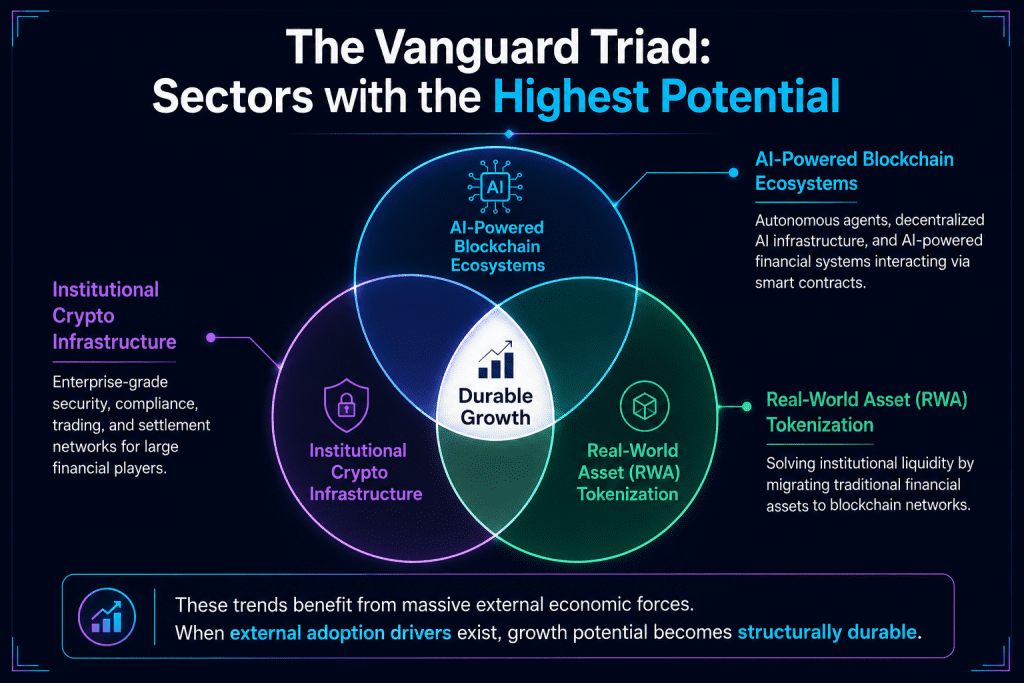
However, many analysts view three sectors as particularly important:
- AI-powered blockchain ecosystems
- Real-world asset tokenization
- Institutional crypto infrastructure
These trends benefit from broader economic forces extending beyond crypto itself.
When external adoption drivers exist, growth potential often becomes more durable.
FAQs About Crypto Trends in 2026
What is the biggest crypto trend for 2026?
Many industry observers believe AI-powered crypto ecosystems and real-world asset tokenization are among the strongest trends due to their potential for large-scale adoption.
Are AI crypto projects still early?
Yes. While AI-related tokens have gained attention, autonomous agents, decentralized AI infrastructure, and AI-powered financial systems remain in relatively early stages.
Why is tokenization important?
Tokenization allows traditional assets such as real estate, bonds, and commodities to become more accessible, transparent, and transferable through blockchain networks.
What is DePIN in crypto?
DePIN stands for Decentralized Physical Infrastructure Networks. These projects use blockchain incentives to coordinate physical infrastructure such as wireless networks, computing power, storage, and energy systems.
How can investors identify emerging crypto trends early?
Investors often monitor developer activity, adoption metrics, institutional participation, revenue generation, and technological innovation before trends become widely discussed.
The Quiet Advantage Behind Major Market Trends
Every crypto cycle creates visible winners and invisible enablers.
Most market participants focus on the assets making headlines. Professionals often spend more time studying the forces shaping those headlines.
The most significant opportunities frequently emerge before narratives become obvious. By the time a trend dominates social media, much of the asymmetrical advantage may already be gone.
The challenge is not finding more information.
It is learning which information matters.
Reading Trends Before They Become Headlines
In every market cycle, there is a meaningful difference between reacting to trends and identifying them early.
The traders and investors who consistently stay ahead of the crowd rarely rely on headlines alone. They pay attention to shifts in sentiment, unusual whale activity, volume anomalies, volatility expansions, and structural changes occurring beneath the surface of the market.
This is where PRO Paradiser and its MCP Intel PRIVATE intelligence layer become particularly valuable.
Rather than focusing exclusively on price action, MCP Intel PRIVATE provides structured market intelligence that helps traders understand multiple dimensions of market behavior. The system includes fear and greed sentiment tracking, whale activity monitoring, volume divergence analysis, volatility alerts, support and resistance mapping, multi-timeframe monitoring across 15-minute, 1-hour, 4-hour, and daily charts, and probability-scored alerts designed to provide deeper context around evolving market conditions.
These are the same categories of intelligence that many professional market participants use when evaluating emerging opportunities. While no system can predict the future, having a structured framework often helps traders separate meaningful signals from market noise.
For those interested in exploring this intelligence-driven approach, selected updates are available through MCP Intel FREE at https://t.me/MCP_Intel, while the complete MCP Intel PRIVATE experience is included within PRO Paradiser.
In rapidly evolving markets, information alone is rarely enough. The real advantage often comes from understanding how seemingly disconnected signals begin to align before the broader market notices.
What is different here
Most guides stop at the theory. The MyCryptoParadise team shares the live trades, and the reasoning behind each one, inside ParadiseFamilyVIP. Everything here is education, not financial advice.
Crypto trading involves substantial risk and is not suitable for everyone. Nothing here is financial advice; it is education only. Never risk more than you can afford to lose.









Join the discussion
No comments yet. Members, share how you are reading this.