

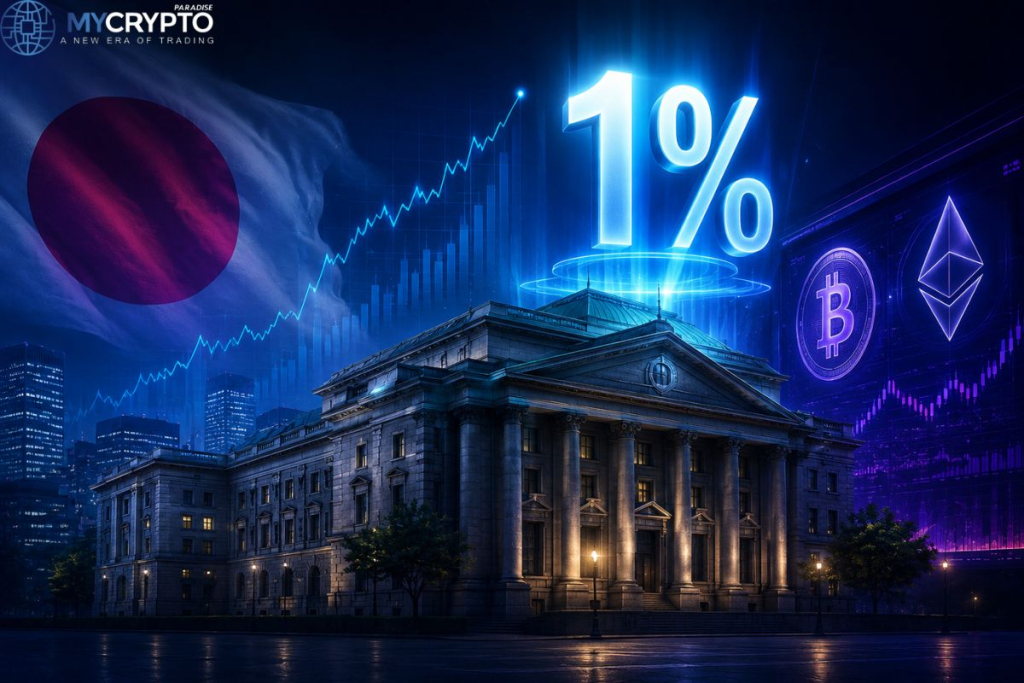
- Bank of Japan raised rates from 0.75% to 1%.
- The new rate marks Japan’s highest level since 1995.
- Markets are assessing the impact on global liquidity and risk assets.
For years, traders assumed Japanese money would remain cheap forever. Japan interest rates are telling a different story now. Could one of the world’s biggest liquidity engines be changing direction?
The Bank of Japan has taken another significant step away from the extraordinary monetary policies that defined much of the last three decades. On Tuesday, policymakers raised the benchmark policy rate from 0.75% to 1%, marking the highest interest rate level in Japan since 1995. While the increase may appear modest by international standards, the symbolism is difficult to ignore.
The decision comes as inflation pressures continue to reshape the economic landscape. Rising energy costs, amplified by recent geopolitical tensions in the Middle East, have contributed to higher living expenses and renewed concerns about price stability.
According to economist Jesper Koll, Japan has moved from a prolonged period of deflation into an inflationary cycle, reducing the need for emergency monetary support.
The significance extends far beyond Japan. Japanese investors are a major source of global liquidity, and higher interest rates could reduce the incentive to send capital abroad in search of better returns.
For crypto traders, the story is not simply about Japan. It is about liquidity. The driver is higher Japan interest rates. The macro effect is tighter financial conditions. The liquidity effect could influence global capital flows, with potential consequences for Bitcoin, Ethereum, and broader risk assets.
Why Japan Interest Rates Matter for Crypto
Japan interest rates matter because they influence one of the largest pools of capital in the global financial system. For decades, ultra low rates encouraged Japanese investors to seek returns outside domestic markets. That flow of capital became an important source of liquidity across global assets.
The key driver is the Bank of Japan’s gradual move away from ultra loose monetary policy. As rates rise, investors may become less willing to seek returns abroad, potentially reducing global liquidity flows.
Crypto markets have become increasingly sensitive to these broader liquidity dynamics. Bitcoin, Ethereum, and altcoins often react not only to industry specific developments but also to shifts in global monetary conditions.
Bitcoin may feel the impact first because institutional investors often treat it as a macro sensitive asset. A world where Japanese rates continue rising could encourage some capital to remain within traditional financial instruments rather than flowing into speculative assets.
Ethereum faces a similar challenge, although its broader utility narrative provides additional support. If global liquidity conditions become less favorable, investors may become more selective about which digital assets deserve capital allocation.
Altcoins are generally the most sensitive segment because they sit furthest down the liquidity chain. The sequence is often straightforward: tighter liquidity affects Bitcoin first, Ethereum second, and altcoins most aggressively. That does not guarantee immediate weakness, but it does increase the importance of monitoring monetary policy developments.
Market Impact of Japan Interest Rates
The immediate market impact of higher Japan interest rates extends beyond the domestic economy. Global investors closely monitor Bank of Japan policy because Japan has historically been a major exporter of capital through institutional funds, insurers, pension managers, and retail investors.
The most important macro implication is the potential reduction of global liquidity. When Japanese yields were near zero, investors had strong incentives to deploy capital internationally. Higher domestic yields can gradually alter that calculation.
One area traders frequently discuss is the yen funded carry trade. For years, low Japanese borrowing costs encouraged investors to borrow cheaply and invest in higher yielding assets elsewhere. As interest rates rise, those trades become less attractive, potentially reducing liquidity available to global markets.
Bitcoin could face headwinds if rising Japanese rates contribute to tighter global financial conditions. Institutional investors increasingly evaluate Bitcoin within the context of broader macro trends rather than treating it as an isolated asset class. Reduced liquidity typically makes capital more selective.
Ethereum may experience similar pressure if risk appetite weakens. However, Ethereum’s growing role in tokenization, stablecoins, and digital finance provides additional demand drivers beyond macro speculation alone.
Altcoins often experience amplified reactions because they rely heavily on abundant liquidity and investor willingness to take risk. A prolonged period of tighter financial conditions would likely affect them more than larger, more established assets.
The market is not reacting to a 0.25% increase. It is reacting to the possibility that Japan’s long era of ultra loose money is ending.
What to Watch Next After the BOJ Rate Hike
The most important question now is whether the latest move represents another step in a longer tightening cycle or the beginning of a more gradual stabilization phase. Markets care less about where rates are today than where they might be tomorrow.
Traders should closely monitor future Bank of Japan communications. Policymakers have emphasized that rate increases are tied to inflation dynamics and economic conditions. If inflation remains persistent, additional tightening cannot be ruled out.
Currency markets also deserve attention. The Japanese yen has become a key indicator of how investors interpret policy changes. A stronger yen could influence global capital flows and affect risk sentiment across asset classes.
For crypto markets, liquidity matters more than rate decisions alone. Global liquidity, bond yields, central bank policy, and capital flows will likely provide the clearest signals, while Bitcoin’s reaction may show whether investors see the BOJ’s move as isolated or part of a broader tightening cycle.
Confirmation of the bearish liquidity thesis would involve additional rate hikes, rising domestic Japanese yields, stronger yen performance, and evidence of reduced risk appetite across financial markets. Invalidation would emerge if markets absorb the change smoothly and global liquidity remains resilient.
Insights for Traders on Japan Interest Rates
For traders, the key lesson is understanding the difference between a local economic event and a global liquidity event. The Bank of Japan’s decision falls into the second category because of Japan’s outsized influence on international capital flows.
The driver is higher Japan interest rates. The macro effect is monetary normalization after decades of extraordinary support. The liquidity effect comes through capital allocation decisions, carry trades, and investor risk preferences. From there, the impact spreads through Bitcoin, Ethereum, and the broader crypto ecosystem.
Bitcoin remains the primary asset to watch because it often acts as the first receiver of global liquidity changes. Strong institutional participation has made Bitcoin increasingly sensitive to shifts in macro conditions. If liquidity tightens, Bitcoin is likely to reveal that change before much of the broader crypto market.
Ethereum follows a similar pattern but may benefit from additional demand linked to tokenization and digital finance infrastructure. Those factors can sometimes offset part of the pressure created by tighter liquidity conditions.
Altcoins remain the highest beta segment. If global liquidity stays strong despite higher Japanese rates, they could continue performing well. If liquidity weakens materially, they are likely to feel the greatest impact.
Confirmation of the market’s concerns would require further tightening and evidence that capital is becoming more defensive. Invalidation would come from stable liquidity conditions despite higher rates.
For years, investors asked when Japan would return to normal monetary policy. The Bank of Japan is increasingly providing an answer.
ParadiseTeam is monitoring the market situation closely, and we are taking these developments into consideration while building our trading tactics inside ParadiseFamilyVIP.
Will the Bank of Japan raise interest rates again?
This is how the Paradisers are calling it. Tap your call.
No calls on this one yet. Tap yours to be the first.
Free account, no password. Members just sign in.











Join the discussion
No comments yet. Members, share how you are reading this.