

Stablecoin Safety
In short
No single stablecoin is universally safest; their stability depends on their backing mechanism and market conditions. Fiat-backed stablecoins like USDT and USDC offer liquidity but require trust in the issuer, while crypto-backed stablecoins like DAI provide transparency but carry liquidation risk. Algorithmic stablecoins prioritize efficiency but are reliant on user confidence to maintain their peg.
The Illusion of Stability: Not All Dollars Are Equal
It sounds simple. Almost deceptively simple, one token equals one dollar.
And yet, this is where most people get caught unaware, not all dollars are created equal.
In crypto space, two assets can sit comfortably at “$1” and behave like completely different species the moment pressure shows up. In calm markets, you won’t notice. Everything looks fine, no pressure, no fear. Until it isn’t.
Picture five people offering you one dollar. One is holding cash right in front of you. Another says it’s in a bank somewhere. A third points to a pile of volatile assets. One relies on a system that “should” work. The last just asks you to trust them.
Similar promises with different realities, that is stablecoins.
They aren’t defined by the number on the screen.
They’re defined by market storms.
Stability isn’t about sitting at one dollar today. It is importantly about how it stabilizes during the calm period and turbulence.
Choose Your Shelter: The Three Types of Stablecoins
When markets are quiet, everything feels dependable. Pegs hold. Charts barely move up or down. One can easily assume all stablecoins are stable in actual sense. That can be deceptive
The moment volatility enters, the thought changes, then fear enters.
You’re choosing a place to stand when things get uncomfortable.
And some places hold up better than others.
The Bank Vault: Fiat-Backed Stablecoins
This is the structure quite a lot of people understand instinctively. Stablecoins like USDT and USDC claim that each token is backed by real-world reserves, which is cash or treasury bills.
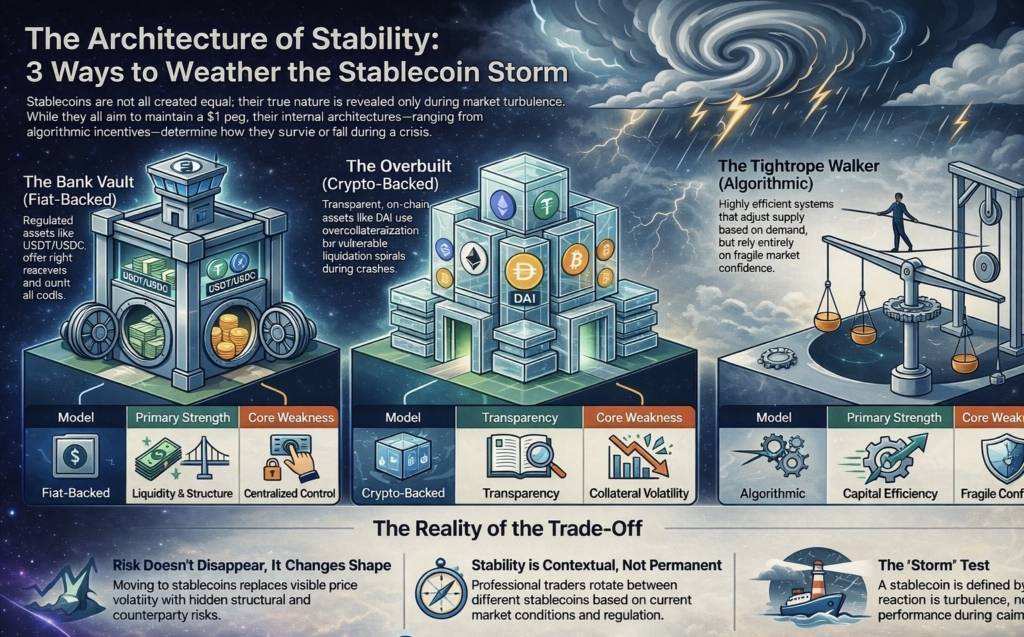
Think of a vault like a heavy door. Cameras. Layers of security. Inside, the value is supposed to sit quietly, doing nothing aside backing your digital dollar.
It feels solid. And to be fair, in most conditions, it is.
These coins dominate liquidity. Their peg is usually tight. They move seamlessly across several crypto exchanges. In normal and even choppy market conditions, they act exactly as you’d think.
But there’s a detail people tend to overlook.
The strength of the vault isn’t the only question.
It’s who decides when it opens.
Because under stress, the risk shifts direction. It’s no more about whether the reserves exist. The attention shifts to accessibility.
Accounts can freeze. Redemptions can slow. Rules can change faster than you’d like.
The system works. But it’s not entirely in your hands.
The vault is strong. Just that it doesn’t belong to you.
The Overbuilt Bunker: Crypto-Backed Stablecoins
Now we shift into a different mindset.
Crypto-backed stablecoins like DAI or LUSD remove the bank entirely. Instead, they rely on overcollateralization. You don’t trust an issuer. You lock more value than you borrow.
To mint $100, you might lock around $150 or even more.
It’s excessive by design.
Think of it as a bunker built with extra layers. Reinforced. Overprepared. Almost paranoid.
That excess is the protection.
Everything is visible on-chain. No guessing. No hidden balance sheets. No central authority quietly makes decisions behind the curtain.
It aligns with the ethos of crypto. And that matters.
But there’s a catch. There’s always a catch.
The bunker sits on volatile ground.
If the collateral drops too quickly, the buffer shrinks. And when it crosses a certain point, the system doesn’t hesitate to liquidate.
In fast market conditions, this can spiral.
Liquidations trigger selling pressure, selling pressure forces prices lower. The system reacts again. And the loop feeds itself.
It’s engineered to survive.
But it’s tied directly to the same volatility it’s trying to defend against.
The Tightrope Walker: Algorithmic Stablecoins
Then you have the ambitious ones. Algorithmic stablecoins try to solve the problem without heavy reserves or excessive collateral. They rely on mechanisms, incentives and supply adjustments.
Balance, in its purest form.
Imagine a tightrope walker.
As long as they keep adjusting, everything works. The system expands and contracts supply, trying to stay aligned with demand.
In stable conditions, it can feel elegant, efficient, and a bit clever.
But stability here depends on fragility.
Confidence.
Once conditions shift, the balancing act becomes harder. The system reacts, but markets don’t wait. Sentiment moves faster than code.
And when confidence cracks, it doesn’t crack gently. It cascades.
Selling creates imbalance. Imbalance breaks the peg. The broken peg creates fear. And fear accelerates everything.
There’s no slow failure, just a sudden drop.
The Real Trade-Off: There Is No Perfect Shelter
Step back for a second.
Each model solves a problem. And introduces a new one.
The vault gives you structure, but requests for trust.
However, the bunker gives you transparency, but there is volatility.
The tightrope gives you efficiency, but depends on belief.
Nothing is actually free.
This is where a lot of discussions go wrong. They try to label one option as “best.” Meanwhile, it doesn’t work this way. You’re not choosing perfection. You’re choosing which weakness you can survive with.
Why Most Traders Misjudge Stablecoins
Here’s the mistake. And it’s a common one.
Traders treat stablecoins as neutral ground. A place where risk disappears.
They exit positions. Move into a stablecoin. And mentally relax.
But the risk hasn’t disappeared.
It’s just changed shape.
Visible volatility is gone. Structural risk takes its place.
It’s like leaving a burning building and stepping onto a bridge without checking what’s holding it up. Nothing looks wrong, until it is.
A Smarter Perspective: Stability Is Contextual
This is the shift that matters.
There isn’t a single safest stablecoin.
There’s only what makes sense right now.
In calm markets, efficiency might win.
In uncertain conditions, transparency starts to matter more.
When regulation tightens, compliance becomes the deciding factor.
Safety moves.
Professional traders adapt and rotate, they don’t just stick to a single system (The ParadiseTeam Ideology).
Because survival in this market isn’t about making one correct choice.
It’s about collective choices as the market evolves.
Comparison: Best Stablecoins in 2026
| Stablecoin | Best For | Core Strength | Main Tradeoff |
|---|---|---|---|
| USDT | Active trading | Deepest exchange liquidity | Ongoing perception and transparency debates |
| USDC | Conservative treasury parking | Cleaner disclosure profile | Less universal trading depth than USDT |
| DAI | DeFi native strategies | Decentralized composability | More complexity |
| PYUSD | Payments and mainstream finance bridge | PayPal distribution and brand | Less core trading dominance |
| RLUSD | Enterprise and settlement watchlist | Ripple ecosystem positioning | Newer stress history |
| FDUSD | Exchange specific utility | Practical venue integration | Narrower network effect |
Final Thought: Stability Is a System, Not a Label
A stablecoin isn’t defined by the number it shows.
It’s defined by the structure behind it.
- What actually backs it
- Who controls it
- What is the reaction during turbulence
“Stable” is just a label, the reality is more layered and conditional.
And once you start seeing that clearly, stablecoins stop being passive tools.
They become something else entirely. they can be a way you can position yourself while everything else moves.
Where Traders Learn to Think Beyond the Peg
Stablecoins look simple until the market gets complicated.
This is why many traders deepen their understanding of liquidity, custody risk, and market structure through MCP University FREE, where stablecoins are treated not as boring cash substitutes, but as core components of a professional trading system.
When the market turns violent, the strongest portfolios are usually not the ones taking the biggest risks.
They are the ones built on the calmest foundations.
Stablecoins 2026 FAQ
Which stablecoin is safest for traders in 2026?
There is no single perfect answer. USDC tends to feel strongest for conservative, disclosure-focused optics, while USDT remains strongest for raw trading liquidity. DAI is often the most compelling decentralized option.
Which stablecoin is best during a market crash?
Usually the one with the most credible liquidity where you actually need to trade. In practice that often means USDT or USDC, depending on the venue and your strategy.
Are newer stablecoins like PYUSD and RLUSD worth using?
They can be, if they solve a real workflow problem. PYUSD and RLUSD are tied to larger payment and enterprise narratives rather than being new for novelty's sake.
Can one stablecoin do everything?
Usually no. Professionals often use different stablecoins for different jobs, such as trading, treasury parking, DeFi collateral, and payments, matching each coin to its strongest use case.
Crypto trading involves substantial risk of loss. This article is educational and is not financial advice. Past performance does not guarantee future results. Always do your own research.
What is different here
Most guides stop at the theory. The MyCryptoParadise team shares the live trades, and the reasoning behind each one, inside ParadiseFamilyVIP. Everything here is education, not financial advice.
Crypto trading involves substantial risk and is not suitable for everyone. Nothing here is financial advice; it is education only. Never risk more than you can afford to lose.






Join the discussion
No comments yet. Members, share how you are reading this.