• Bill Gates Foundation sells its final 7.7 million Microsoft shares worth $3.2 billion
• Microsoft stock slips as markets absorb one of the company’s largest legacy exits
• Investors debate whether the sell-off is bearish or simply part of the Foundation’s 2045 wind-down plan
Microsoft just lost one of its most symbolic long-term holders, but is this a warning sign for markets, or simply a massive liquidity reshuffle?
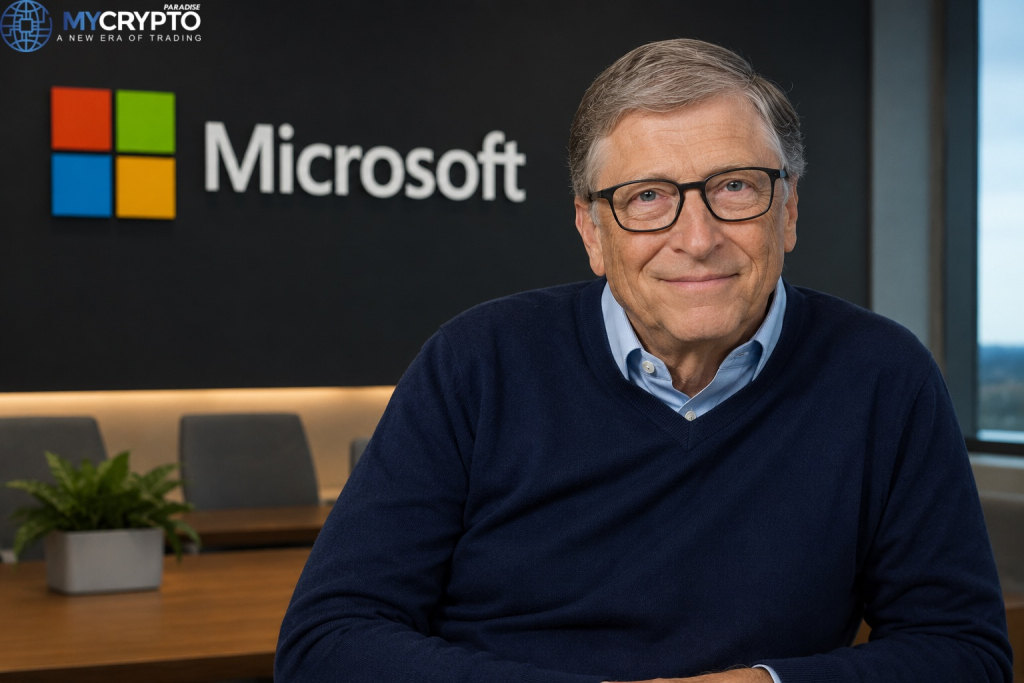
Microsoft shares experienced a decline after it was disclosed that the Bill & Melinda Gates Foundation Trust sold its last 7.7 million shares of Microsoft during the first quarter, completely exiting a position that had previously been valued at over $10 billion.
This stake, which is now worth around $3.2 billion at current market prices, represented the end of a historically significant relationship for the company with one of its major shareholders. At the time this information was reported, Microsoft stock was trading close to $422, having dropped about 0.42% following the announcement.
Why the Gates Foundation Selling Microsoft Stock Matters
The sale of the final Microsoft shares by the Gates Foundation is significant because markets tend to react when well-known long-term investors completely exit large holdings. At first glance, the headline may seem negative.
A $3.2 billion sale associated with Bill Gates raises concerns that insiders or long-term investors may anticipate lower potential gains in the future. However, the underlying situation appears to be more about structural changes rather than a directional shift.
The Foundation has publicly stated its intention to significantly increase annual grant distributions while also planning to wind down its entire endowment by 2045. Selling off its concentrated Microsoft shares is one of the simplest methods to generate the long-term liquidity needed for these goals. This distinction is crucial. The sale was not a sudden liquidation caused by a loss of confidence in Microsoft’s business model or its AI strategy.
The position primarily existed because Gates had donated Microsoft stock over many years, rather than the Foundation actively building a traditional market position.
Nonetheless, markets usually do not overlook supply dynamics. Even planned exits can create temporary pressure because large-scale selling introduces more shares into the market, which forces investors to reevaluate how much demand there is at current price levels.
Market Impact of the Microsoft and Gates Foundation Sell-Off
The immediate impact of this sale was as much psychological as it was financial. Microsoft has become a key player in the broader rally driven by AI-related equities. Any news involving billions of dollars of Microsoft stock changing hands can influence sentiment across technology markets.
Additionally, the situation became more complex when billionaire investor Bill Ackman revealed a new Microsoft position worth about $2.3 billion through his fund, Pershing Square. This created a notable division in the market. On one side, a long-term holder had completely exited, while on the other side, a high-profile hedge fund manager was entering aggressively.
Ackman characterized the purchase as an opportunity based on Microsoft’s valuation linked to its AI positioning, especially following recent concerns related to OpenAI’s cloud services earlier in the year.
Ackman pointed out that Microsoft was trading at around 21 times forward earnings, which is below its historical premium levels, despite being one of the strongest players in AI infrastructure globally.
However, Ackman’s buying only partially countered the selling pressure from the Foundation. This imbalance was significant during the day because markets needed to deal with the influx of millions of additional shares.
Meanwhile, institutional views on Microsoft are increasingly divided. Some funds still see the stock as a leading player in AI infrastructure, while others are skeptical about whether the optimism surrounding AI has already been overly factored into the valuations of large tech stocks.
What to Watch Next for Microsoft After the Gates Foundation Exit
The next major point of interest is whether Microsoft can keep its leadership position in the AI sector. The company is closely tied to overall market sentiment regarding AI infrastructure, cloud computing, and demand for enterprise software.
Developments related to partnerships with OpenAI, monetization of AI, and adoption by enterprises will continue to influence discussions about valuations in the upcoming quarters.
Investors are also observing whether other large institutional investors will reduce their exposure following the Foundation’s exit. This does not automatically indicate that a wave of selling is imminent.
However, exits by long-standing holders often prompt broader reviews of portfolios within institutional markets. Another critical factor is Microsoft’s role within the S&P 500. Since Microsoft holds a substantial weighting in major indices, any weakness in its stock can affect the performance of broader equities beyond just Microsoft itself.
This creates secondary effects on passive flows, ETF allocations, and global risk sentiment. The next earnings report will likely be crucial in determining if the recent weakness is merely a temporary issue related to positioning or the start of a more widespread decline in valuations for major AI stocks.
Trader Insights on the Microsoft $3.2B Sell-Off
Traders are distinguishing between the narrative and the mechanics of the situation. The narrative suggests that entities linked to Bill Gates sold billions in Microsoft stock. The mechanics indicate that a charitable foundation is restructuring its liquidity in preparation for a long-term spending plan.
This distinction is important because markets can often overreact to symbolic exits before later reassessing the underlying reasons. At the same time, traders are closely monitoring how Microsoft performs in relation to the overall enthusiasm for AI.
If strong narratives around AI cannot fully absorb large institutional selling pressure, it may indicate that positioning in major tech stocks has become more crowded and less stable than many investors currently believe.
The secondary effects are also significant. When iconic positions are unwound, markets begin to reassess the concentration risk across the entire tech sector.
Microsoft has been a key support for AI optimism, institutional investments, and overall equity stability during recent periods of volatility. Any sustained weakness in Microsoft could have repercussions that extend far beyond just one stock.
At this moment, this issue is not solely about Microsoft. It is about market concentration within the context of the AI boom.
ParadiseTeam is monitoring the market situation closely, and we are taking these developments into consideration while building our trading tactics inside ParadiseFamilyVIP.