● Stellar’s RWA market cap excluding stablecoins increased 91% QoQ from $796 million to $1.52 billion at Q1 end, then surpassed $2 billion on April 11, showing strong momentum in tokenized real world assets.
● Government treasury assets drove the RWA growth, including Ondo’s USDY and Spiko’s EUTBL, USTBL, and UKTBL, strengthening Stellar’s position in institutional tokenized finance.
● x402 launched on Stellar in March and the Machine Payments Protocol launched in April, creating a catalyst for agentic payments that could push average daily payment transactions above the past year’s 1.7 million to 3.7 million range, after 1.9 million in Q1’26.
● Templar launched lending and borrowing for six freely transferable RWAs on April 1, including Centrifuge’s deJAA and deJTRSY and Etherfuse’s CETES and USTRY, supporting potential DeFi TVL growth beyond $174.4 million in Q2 2026.
● Stellar’s stablecoin market cap increased 22% QoQ from $244 million to $297 million, driven by USDC’s 14.9% QoQ increase to $256.3 million and SG FORGE’s EURCV launch on March 10, 2026, improving liquidity for payments, RWAs, and DeFi.
Intro: The Network Becoming Useful in All the Right Places
💎 The biggest infrastructure in crypto rarely makes the most noise, and that’s exactly why it matters. While the market chases the next “Ethereum killer” or AI driven narrative, Stellar has been quietly scaling the one thing that truly counts: real world assets, machine payments, and DeFi composability. Not promises, not testnets, real tokenized value, moving in size.
💎 Stellar’s RWA market cap excluding stablecoins increasing 91% QoQ from $796 million to $1.52 billion at Q1 end and surpassing $2 billion on April 11 isn’t a metric, it’s a signal. This is no longer a blockchain experiment, it is a functioning financial rail. As Q2 2026 unfolds, Stellar is crossing a critical threshold, evolving beyond its identity as a payments network into a dual engine network driving both tokenized real world assets and machine payments.
The core driver is clear: Stellar is turning RWAs into usable financial infrastructure by combining tokenized treasury growth, machine payment rails, DeFi composability, stablecoin liquidity, and privacy ready architecture.
That matters because the next phase of crypto will not only be about issuing assets onchain. It will be about making those assets useful. Tokenized treasuries need liquidity. Machine payments need settlement rails. Institutions need privacy and compliance. DeFi needs collateral. Stellar is quietly connecting those pieces together, which is terribly inconvenient for anyone still trying to value blockchains purely by how loudly their community types in all caps.
Why This Matters: RWAs Are the Core Driver
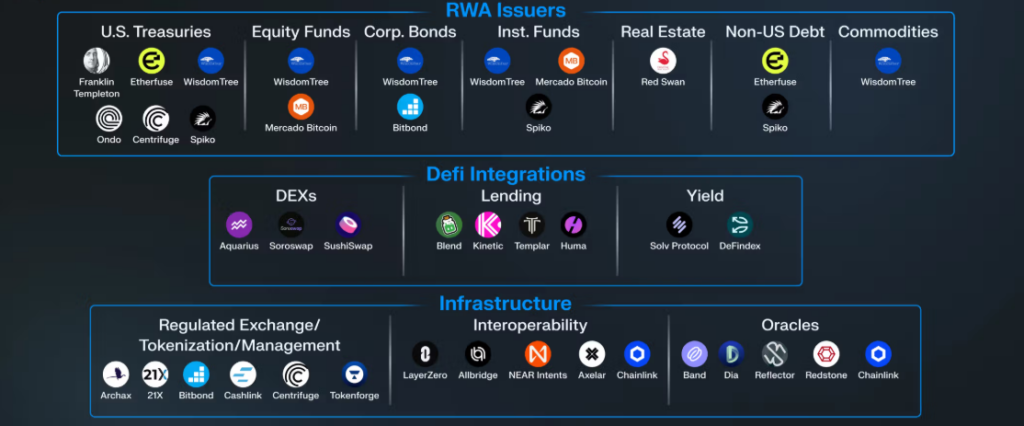
Stellar’s Q1 story starts with real world assets. Everything else, including machine payments, DeFi growth, stablecoin liquidity, and privacy infrastructure, connects back to this central theme.
The numbers are direct:
● Stellar’s RWA market cap excluding stablecoins increased 91% QoQ from $796 million to $1.52 billion at Q1 end
● RWA market cap surpassed $2 billion on April 11
● Growth was driven by government treasury assets, including Ondo’s USDY and Spiko’s EUTBL, USTBL, and UKTBL
This is not just asset growth. It is institutional financial inventory moving onchain.
When tokenized treasury assets grow on Stellar, more capital sits inside the network. When more capital sits inside the network, there is more demand for liquidity, lending, borrowing, and settlement. When those financial activities expand, Stellar becomes more relevant as infrastructure. That is how RWA growth becomes market power.
In simple terms, where tokenized assets gather, liquidity starts to organize. Where liquidity organizes, DeFi becomes useful. Where DeFi becomes useful, markets begin to pay attention.
Stellar is no longer just moving payments. It is beginning to support the financial assets those payments may settle around.
Market Impact: Reading BTC, ETH, and Alts Through Stellar
Stellar’s RWA growth does not only affect XLM. It adds another signal to the broader crypto market that real financial assets are becoming part of onchain liquidity.
For BTC, Stellar’s RWA expansion supports the wider institutional adoption narrative. Bitcoin remains the market’s main store of value asset, but the growth of tokenized treasuries on Stellar strengthens the argument that crypto rails can carry real financial activity. When institutional confidence in blockchain infrastructure improves, BTC can benefit through stronger risk appetite and deeper confidence in the asset class.
For ETH, the impact is more competitive. Ethereum remains the dominant network for DeFi and tokenized asset ecosystems, but Stellar is building a focused lane around RWAs, payments, and composability. The launch of Templar lending and borrowing on April 1 for six freely transferable RWAs, including Centrifuge’s deJAA and deJTRSY and Etherfuse’s CETES and USTRY, makes Stellar more relevant because tokenized assets are becoming usable inside DeFi.
For alts, Stellar shows what the market may increasingly reward: real asset growth, stablecoin liquidity, and measurable usage. Narratives can still move prices, but infrastructure with growing financial assets has a stronger foundation. In a market full of shiny promises, Stellar is bringing the paperwork, the yield instruments, and apparently the sensible shoes.
| Market Segment | How Stellar’s Core Driver Matters | Market Meaning |
| BTC | Stellar’s RWA growth supports the case for crypto as real financial infrastructure. | This strengthens broader institutional confidence in blockchain based markets. |
| ETH | Stellar is expanding RWA composability and DeFi usage. | This increases competition in tokenized finance, especially around treasury backed assets. |
| Alts | Stellar combines RWA growth, stablecoin liquidity, and machine payment catalysts. | Capital may rotate toward networks with measurable utility rather than pure narrative momentum. |
The key point is simple: Stellar does not need to be the loudest chain. It needs to be the chain where useful financial activity keeps increasing.
Network Performance: Real Asset Growth Without the Noise
Stellar’s Q1 metrics show a network moving from basic payment identity toward a more complete financial infrastructure role.
| Metric | Q1 2026 | QoQ Change | Interpretation |
| RWA Market Cap Excluding Stablecoins | $1.52 billion at Q1 end | +91% from $796 million | Strong growth in tokenized real world assets |
| RWA Market Cap After Q1 | Surpassed $2 billion on April 11 | Not provided | Continued momentum after Q1 |
| Average Daily Payment Transactions | 1.9 million | Within past year range of 1.7 million to 3.7 million | Machine payments could push activity above recent range |
| DeFi TVL | $174.4 million at Q1 end | Not provided | Base for projected Q2 2026 growth |
| Stablecoin Market Cap | $297 million | +22% from $244 million | Stronger settlement and liquidity base |
| USDC on Stellar | $256.3 million | +14.9% | Main stablecoin liquidity driver |
| SG FORGE EURCV | Launched March 10, 2026 | New launch | Adds euro stablecoin infrastructure |
| X Ray Privacy Upgrade | Went live Jan. 22 | New upgrade | Supports privacy preserving and compliant applications |
| Templar RWA Lending and Borrowing | Launched April 1 | New launch | Expands DeFi composability for RWAs |
The most important point is that Stellar’s RWA growth is becoming more useful because it is being connected to DeFi.
A tokenized treasury sitting idle is interesting. A tokenized treasury that can be borrowed against, lent, composed, and settled around is far more important.
That is the difference between putting a financial asset onchain and turning it into working financial infrastructure.
The Most Important Metric Nobody Talks About: RWA Composability
The headline number is the 91% QoQ increase in RWA market cap excluding stablecoins. But the deeper signal is composability.
On April 1, Templar launched lending and borrowing for six freely transferable RWAs on Stellar, including Centrifuge’s deJAA and deJTRSY and Etherfuse’s CETES and USTRY.
That matters because RWAs become more valuable when they can be used inside financial applications.
When RWAs can be lent and borrowed, they become collateral. When they become collateral, they support credit markets. When they support credit markets, they can increase DeFi TVL. When DeFi TVL increases, Stellar becomes more than a place where assets exist. It becomes a place where assets work.
This is classic infrastructure progression.
First, the network moves value. Then it stores value. Then it lets users build financial activity around that value.
Or, in less formal terms, Stellar is trying to make RWAs do something more productive than sit there looking institutional.
Stablecoins: The Liquidity Layer Behind the RWA Story
Stellar’s stablecoin growth strengthens the same RWA narrative.
Stablecoin market cap increased 22% QoQ from $244 million to $297 million. USDC increased 14.9% QoQ to $256.3 million. SG FORGE launched EURCV on Stellar on March 10, 2026.
This matters because RWAs need settlement liquidity.
When stablecoin liquidity grows, users can move in and out of tokenized assets more efficiently. When users can move efficiently, RWA markets become more practical. When RWA markets become more practical, DeFi integrations become more useful.
Stablecoins are the cash layer. RWAs are the yield layer. DeFi composability is the activity layer.
Stellar’s Q1 data shows all three developing together.
Privacy Infrastructure: Compliance Without Killing Utility
On Jan. 22, the X Ray privacy protocol upgrade went live on Stellar. This laid the groundwork for zero knowledge cryptography so developers can build privacy preserving, regulatorily compliant applications on the network.
This is directly connected to the RWA story.
Institutional assets require privacy. They also require compliance. The difficult part is building systems that can protect sensitive information while still meeting regulatory requirements.
Zero knowledge cryptography can help support that balance. For Stellar, the X Ray upgrade improves the foundation for applications that need both controlled transparency and user privacy.
This matters because serious financial institutions are unlikely to move meaningful assets into systems that are either fully exposed or impossible to supervise. Stellar’s privacy work gives the network a stronger foundation for institutional RWA adoption.
Machine Payments: Stellar Enters the Agentic Payment Economy
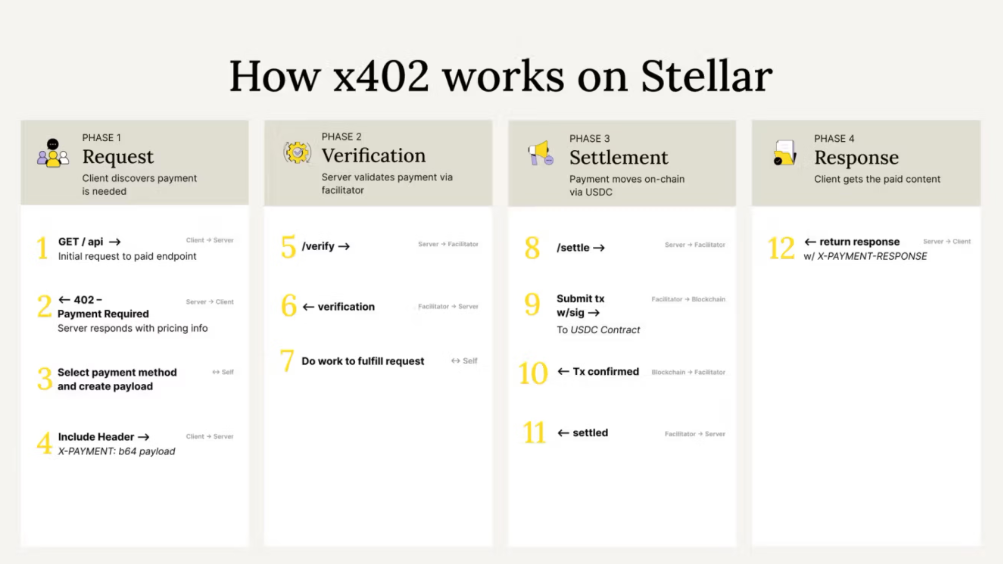
If RWAs are Stellar’s financial asset base, machine payments are the potential transaction engine.
The launch of x402 on Stellar in March and the Machine Payments Protocol in April provides a catalyst for agentic payments. These developments could drive a significant increase in average daily payment transactions beyond the past year’s quarterly range of 1.7 million to 3.7 million, after 1.9 million in Q1’26.
The connection to Stellar’s core driver is important.
Machine payments can create frequent, automated transactions. RWAs and stablecoins provide the financial assets and liquidity those transactions can move around. DeFi composability gives those assets more places to be used.
AI agents and automated systems will need payment rails that are fast, reliable, and liquid. Stellar already has a payments foundation, and now it is adding more institutional asset depth around it.
Machine payments do not care about hype. They care about whether value can move. This is good news for Stellar and bad news for anyone whose entire blockchain strategy is “vibes with a logo.”
Broader Implications: Tokenized Finance Is Becoming Usable
Stellar’s Q1 data points toward a larger market shift. Tokenized assets are no longer just about issuance. The next stage is usability.
The old model was simple. A real world asset gets tokenized, announced, and then mostly admired.
The emerging model is more powerful. A real world asset gets tokenized, settled with stablecoins, used in lending and borrowing, supported by privacy infrastructure, and potentially moved through machine payment systems.
That is the real implication of Stellar’s Q1.
RWA growth increases financial inventory on the network. Stablecoin growth improves settlement liquidity. Templar improves DeFi composability. Blend yields support TVL growth. X Ray supports privacy and compliance. x402 and MPP create a path toward automated payment activity.
Each part reinforces the same driver: Stellar is becoming infrastructure for usable tokenized finance.
What to Watch: The Real Drivers Going Forward
● RWA market cap staying above $2 billion
Stellar surpassed this level on April 11, and holding it would confirm that the growth trend remains intact.
● Government treasury asset growth
Continued expansion from assets such as Ondo’s USDY and Spiko’s EUTBL, USTBL, and UKTBL would strengthen Stellar’s institutional RWA base.
● Average daily payment transactions moving beyond 3.7 million
The past year’s quarterly range was 1.7 million to 3.7 million, with 1.9 million in Q1’26. A move above that range would suggest x402 and MPP are creating real activity.
● DeFi TVL growing beyond $174.4 million in Q2 2026
Templar’s RWA lending and borrowing launch, alongside elevated Blend yields, could support continued growth.
● Stablecoin market cap moving beyond $297 million
More stablecoin liquidity would improve settlement conditions for RWAs, DeFi, and machine payments.
● USDC growth beyond $256.3 million
USDC remains the largest stablecoin liquidity driver on Stellar.
● Adoption of privacy preserving applications after the X Ray upgrade
The market should watch whether developers use the zero knowledge foundation to build compliant financial applications.
● EURCV adoption after the March 10, 2026 launch
SG FORGE’s EURCV adds euro stablecoin infrastructure, and usage growth would expand Stellar’s settlement reach.
Scenarios: Mapping the Future
| Scenario | What Happens | Market Impact |
| Bull Case | Stellar’s RWA market cap holds above $2 billion, DeFi TVL grows beyond $174.4 million in Q2 2026, and payment transactions move above the 1.7 million to 3.7 million range. | XLM could gain stronger recognition as exposure to RWA infrastructure, machine payments, and usable tokenized finance. |
| Base Case | RWA growth remains firm, stablecoin liquidity continues improving, and x402 plus MPP adoption develops gradually. | XLM remains a strong infrastructure narrative with steady upside tied to RWA growth and DeFi composability. |
| Bear Case | RWA market cap loses momentum, payment transactions remain near 1.9 million, and DeFi TVL fails to grow beyond $174.4 million. | The market may treat Stellar’s progress as promising but wait for stronger proof before assigning a larger premium. |
Insights for Traders: Positioning Around Usable Tokenized Finance
● XLM is increasingly tied to the RWA growth cycle
The strongest signal is Stellar’s RWA market cap excluding stablecoins rising 91% QoQ from $796 million to $1.52 billion and surpassing $2 billion on April 11.
● Watch RWA composability, not just RWA issuance
Templar’s launch of lending and borrowing for six freely transferable RWAs matters because usable assets are more valuable than passive assets.
● Stablecoin liquidity supports the whole structure
The 22% QoQ increase in stablecoin market cap from $244 million to $297 million, with USDC rising 14.9% QoQ to $256.3 million, improves settlement depth.
● Machine payments create upside optionality
x402 and MPP could push average daily payment transactions beyond the recent 1.7 million to 3.7 million quarterly range.
● Privacy infrastructure matters for institutions
The X Ray upgrade creates a foundation for privacy preserving, regulatorily compliant applications, which is essential for serious RWA adoption.
● DeFi TVL is the practical confirmation signal
Growth beyond $174.4 million at Q1 end would suggest that RWAs are becoming active inside Stellar’s financial ecosystem.
Forward Trigger: Confirmation vs Invalidation
The confirmation signal is clear. Stellar needs to keep RWA market cap above $2 billion, grow DeFi TVL beyond $174.4 million in Q2 2026, push average daily payment transactions above the 1.7 million to 3.7 million quarterly range, and continue growing stablecoin liquidity beyond $297 million.
The invalidation signal is equally clear. If RWA growth stalls after the April 11 move above $2 billion, if payment activity remains near 1.9 million, if DeFi TVL fails to expand beyond $174.4 million, or if stablecoin liquidity weakens from $297 million, then the market may delay treating Stellar as a leading infrastructure play for usable tokenized finance.
Final Thought: Useful Usually Beats Loud
Stellar is not trying to win the loudest narrative contest.
It is trying to become useful.
That is the point.
Its Q1 2026 data shows a network with 91% QoQ RWA growth, more than $2 billion in RWA market cap after Q1, $297 million in stablecoin market cap, $256.3 million in USDC, new RWA lending and borrowing through Templar, privacy infrastructure through X Ray, and machine payment catalysts through x402 and the Machine Payments Protocol.
The market may still chase louder stories, but capital eventually notices where assets settle, where liquidity forms, and where financial activity becomes repeatable.
Nobody gets excited about financial plumbing until they realize the entire building depends on the pipes.